
No environment demands more from its cleaning regime than a childcare centre. Children put their hands — and everything else — on every surface. Immune systems are still developing. Nappy change areas, food prep zones and play spaces sit metres apart, each with different hygiene requirements. And overseeing it all is a regulatory framework, the National Quality Standard, in which hygiene practices directly affect a centre’s assessment and rating.
Yet many centres run their cleaning off an inherited product cupboard: an accumulation of retail purchases, donated leftovers and whatever the previous director ordered. The result is gaps — the wrong chemical near children, no gloves in the change room, sanitiser that isn’t food-safe on lunch tables. Getting Childcare Cleaning Supplies right isn’t about buying more; it’s about buying deliberately, against a checklist built around how centres actually operate. This article is that checklist.
Zone by Zone: What Every Centre Needs Stocked
The most useful way to audit your supplies is by zone, because each area of a centre carries different risks and different requirements.
Nappy Change and Toileting Areas
This is the highest-risk hygiene zone in the building. Non-negotiables:
- Disposable gloves — nitrile or vinyl, stocked at the change table itself, never “down the hall”
- Baby wipes in bulk supply — a centre burns through these faster than any other consumable
- Disinfectant surface wipes or spray rated for the change mat, used between every change
- Nappy disposal bags and strong bin liners — leaking bags are a hygiene failure and a staff complaint in one
- Paper towel and soap at the adjacent handwash station, always stocked
If any of these runs out mid-shift, correct procedure physically cannot be followed. Stock levels here should be checked daily, not weekly.
Kitchens and Food Areas
Food areas need food-safe products — a general disinfectant isn’t automatically appropriate near food contact surfaces. Stock food-area-appropriate sanitiser, dedicated dishwashing detergent, disposable gloves for food handling, and paper towel that’s actually within reach of the prep bench. Keep these products stored separately from nappy-area chemicals to remove any possibility of mix-ups.
Play Rooms and Sleep Areas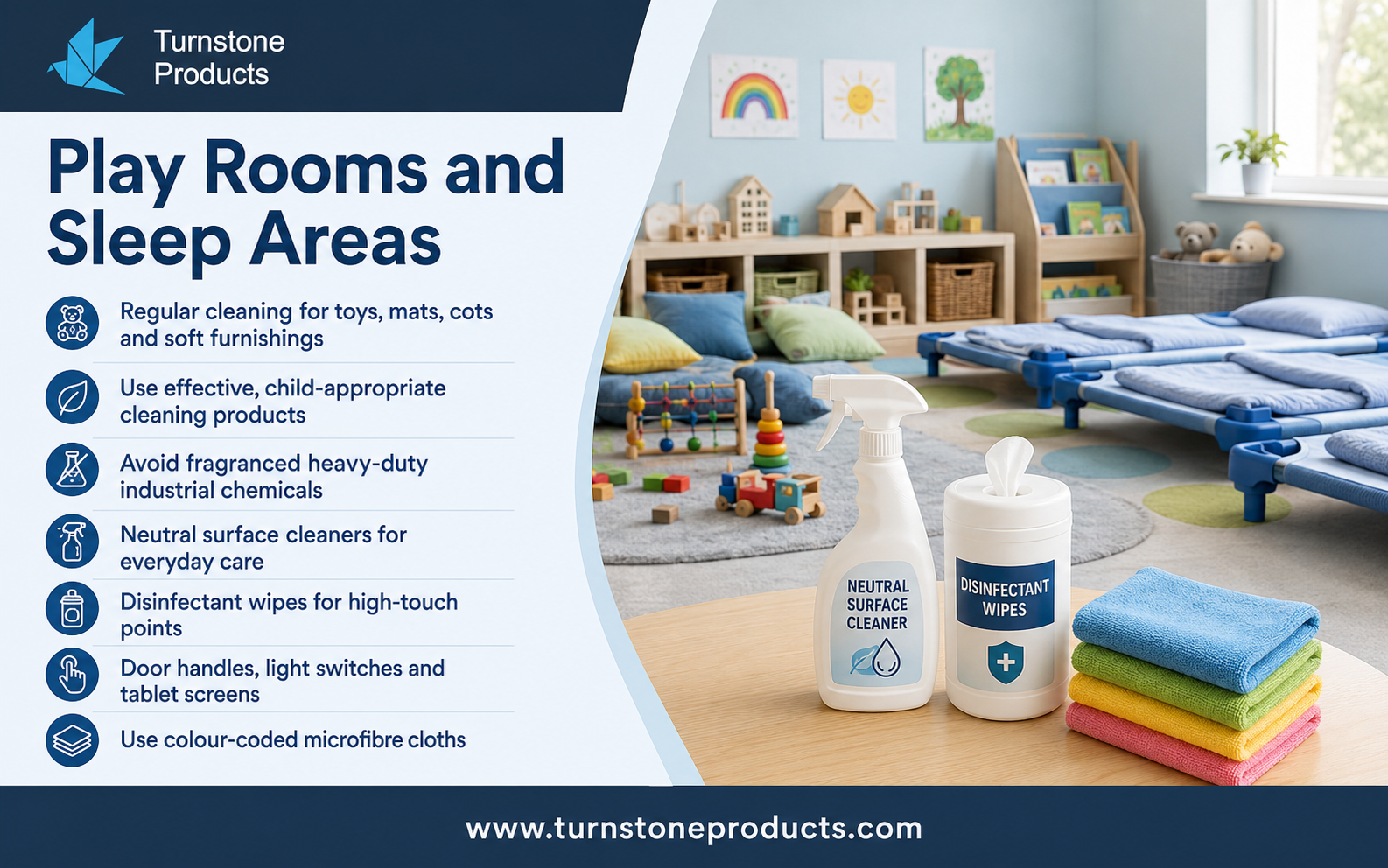
Toys, mats, cots and soft furnishings need regular cleaning with products that are effective but appropriate around children — this is where fragranced heavy-duty industrial chemicals do not belong. Neutral or child-appropriate surface cleaners, disinfectant wipes for high-touch points (door handles, light switches, tablet screens), and microfibre cloths in a colour-coded system keep this zone covered.
Bathrooms and Handwash Stations
Children’s handwashing is the single most effective infection-control measure a centre has, so the supporting supplies matter: mild liquid soap in refillable dispensers, paper hand towels at child height (many centres prefer these over shared cloth towels for hygiene), toilet paper stocked ahead of demand, and daily bathroom disinfectant.
The Chemical Safety Layer Most Centres Miss
Having the right products is half the job. Storing and using them correctly is the other half — and it’s the half assessors look at.
- Lockable, child-inaccessible chemical storage is mandatory practice. No chemicals, including “mild” ones, stored at child height.
- Original containers or properly labelled bottles only. Decanted chemicals in unmarked spray bottles are a common audit finding.
- Safety Data Sheets (SDS) on file for every chemical on site, current and accessible to staff.
- Correct dilution, every time. Over-concentrated chemicals leave residues on surfaces children touch and mouth; under-diluted ones don’t disinfect. Dilution instructions should be posted where mixing happens.
- Colour-coded clothes and mops so bathroom equipment never touches a lunch table.
A supplier who works with childcare centres can help here advising which products suit which zone, and supplying SDS documentation with the chemicals. That’s a genuine advantage of buying childcare cleaning supplies perth from a trade supplier rather than pulling retail products off a shelf: you get products matched to the setting, in commercial pack sizes, with the documentation your compliance folder needs.
The Restock System: Never Run Out of the Critical Items
Almost every hygiene failure in a childcare centre traces back to a stockout, not a knowledge gap. Staff know to glove up at the change table; they can’t if the box is empty. Build a simple system:
- Tier your supplies. Gloves, wipes, soap, paper towel and nappy-area consumables are Tier 1 — these get a daily glance and a generous buffer.
- Set reorder triggers. When the last full carton of any Tier 1 item is opened, it goes on the order that week.
- Order everything monthly from one supplier, on a standing schedule, delivered rather than shopped for. Directors have better things to do than supermarket runs.
- Buy by the carton. Wipes, gloves and paper at childcare consumption rates make wholesale pricing an easy saving.
Why Choose Turnstone Products
Turnstone Products is a Perth B2B supplier that services childcare and early learning centres specifically — stocking the full checklist above from one place. That includes BabyLove and Joey nappies, Turnstone baby wipes, disposable gloves, disinfectant and antibacterial wipes, child-appropriate cleaning chemicals, liquid soaps, paper hand towels and toilet rolls, and strong bin liners — the complete set of childcare essential supplies wholesale a centre runs on, sold by the carton at wholesale pricing. Orders go by quote form or phone rather than an online cart, so you can talk through what suits each zone of your centre, and next-day delivery across the Perth metro means a Tier 1 stockout is fixed by tomorrow morning. Centres that reorder regularly can run a trade account with a standing monthly delivery.
The Takeaway
Childcare hygiene fails at the gaps — the missing gloves, the wrong chemical, the empty dispenser — not at the intentions. Audit your centre zone by zone against this checklist, fix the chemical storage and labelling layer, and put the critical consumables on a carton-quantity standing order so stockouts become impossible. It’s an afternoon’s work to set up, it costs less than retail buying, and it shows up exactly where it matters: in daily practice, in your assessment rating, and in the health of the children in your care.